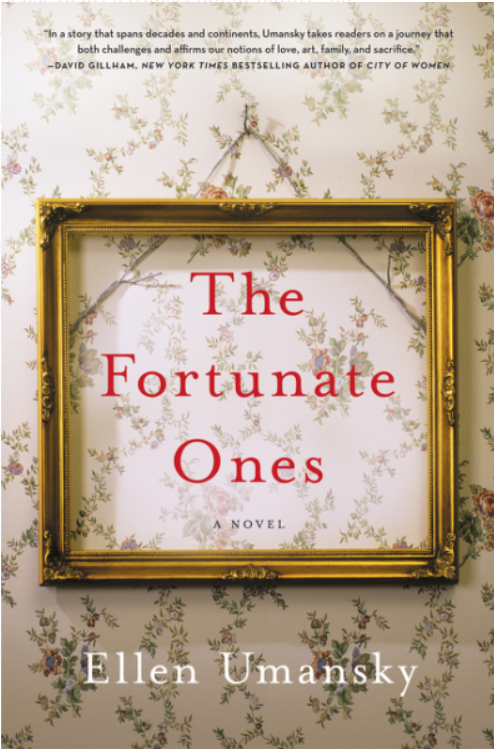
I really enjoyed this book and raced through it. The story deals with a lost painting (it's actually a fictional painting by a real artist - Chaim Soutine - who I learned about at my two visits to the Barnes collection in Philly) and the Holocaust. The story switches back and forth between Lizzie and Rose telling their stories (Rose was the daughter of the owners of the painting that was taken by the Nazis) and Lizzie, living in present day LA and NY and who subsequently owned the same painting, which was again lost!
How did Lizzie get the painting? How did she lose it? How do Rose and Lizzie meet up? What happened to the painting the second time? What happened to Rose's parents?
All of these questions are handled in the book, along with revelations about guilt, friendship, family, and trust.
Read it!
Have been keeping this blog since 2008! It's a place to keep track of what I've read.
Saturday, June 10, 2017
Monday, May 29, 2017
A Separation by Katie Kitamura
Very short but very powerful book. I had it on my "Want To Read" list and found it on the shelf in the Library on Friday and finished it by Sunday.
Here is theAmazon blurb:
A young woman has agreed with her faithless husband: it's time for them to separate. For the moment it's a private matter, a secret between the two of them. As she begins her new life, she gets word that Christopher has gone missing in a remote region in the rugged south of Greece; she reluctantly agrees to go look for him, still keeping their split to herself. In her heart, she's not even sure if she wants to find him. As her search comes to a shocking breaking point, she discovers she understands less than she thought she did about her relationship and the man she used to love.
A searing, suspenseful story of intimacy and infidelity, A Separation lays bare what divides us from the inner lives of others. With exquisitely cool precision, Katie Kitamura propels us into the experience of a woman on edge, with a fiercely mesmerizing story to tell.
Sunday, May 7, 2017
Waking Lions by Ayelet Gundar-Goshen
This was a fabulous read! Gritty, jarring, suspenseful, and above-all else, a psychological study of human beings struggling with guilt, morality, pathos, and much more.
Read the NYTimes review for a spot-on analysis.
Sunday, April 30, 2017
Exit West by Moshin Hamid
This was a really different kind of book for me, but quite amazing in its craft and creativity. I found it to be extremely relevant and timely, given the Syrian refugee crisis.
Here's the Kirkus Review:
Hamid (Discontent and Its Civilizations, 2014, etc.) crafts a richly imaginative tale of love and loss in the ashes of civil war.
The country—well, it doesn’t much matter, one of any number that are riven by sectarian violence, by militias and fundamentalists and repressive government troops. It’s a place where a ponytailed spice merchant might vanish only to be found headless, decapitated “nape-first with a serrated knife to enhance discomfort.” Against this background, Nadia and Saeed don’t stand much of a chance; she wears a burka but only “so men don’t fuck with me,” but otherwise the two young lovers don’t do a lot to try to blend in, spending their days ingesting “shrooms” and smoking a little ganga to get away from the explosions and screams, listening to records that the militants have forbidden, trying to be as unnoticeable as possible, Saeed crouching in terror at the “flying robots high above in the darkening sky.” Fortunately, there’s a way out: some portal, both literal and fantastic, that the militants haven’t yet discovered and that, for a price, leads outside the embattled city to the West. “When we migrate,” writes Hamid, “we murder from our lives those we leave behind.” True, and Saeed and Nadia murder a bit of themselves in fleeing, too, making new homes in London and then San Francisco while shed of their old, innocent selves and now locked in descending unhappiness, sharing a bed without touching, just two among countless nameless and faceless refugees in an uncaring new world. Saeed and Nadia understand what would happen if millions of people suddenly turned up in their country, fleeing a war far away. That doesn’t really make things better, though. Unable to protect each other, fearful but resolute, their lives turn in unexpected ways in this new world.
One of the most bittersweet love stories in modern memory and a book to savor even while despairing of its truths.
Thursday, April 13, 2017
All Grown Up by Jami Attenberg
Deeply perceptive and dryly hilarious, Attenberg’s (Saint Mazie, 2015, etc.) latest novel follows Andrea Bern: on the cusp of 40, single, child-free by choice, and reasonably content, she’s living a life that still, even now, bucks societal conventions. But without the benchmarks of “grown up” success—an engagement, a husband, a baby—Andrea is left to navigate her own shifting understanding of adulthood.
“Why is being single the only thing people think of when they think of me? I’m other things, too,” Andrea says, much to the delight of her therapist, who wants to know, then, what exactly those other things are. She is a woman, Andrea says. A designer who works in advertising; a New Yorker; technically, a Jew. A friend, she tells her therapist. A daughter, a sister, an aunt. Here are the things that Andrea does not say: she’s alone. A drinker. A former artist. A shrieker in bed. At 39, Andrea is neither an aspirational figure nor a cautionary tale of urban solitude. She is, instead, a human being, a person who, a few years ago, got a pair of raises at work and paid off her debt from her abandoned graduate program and then bought some real furniture, as well as proper wine glasses. And still she does not fully compute to the people around her, people whose “lives are constructed like buildings, each precious but totally unsurprising block stacked before your eyes.” Everyone is married or marrying, parenting or pregnant, and it’s not so much that she’s lusting after these things, specifically—neither marriage nor babies is her “bag,” anyway—so much as it’s that her lack of them puts her at odds with the adult world and its definitions of progress. Structured as a series of addictive vignettes—they fly by if you let them, though they deserve to be savored—the novel is a study not only of Andrea, but of her entire ecosystem: her gorgeous, earthy best friend whose perfect marriage maybe isn’t; her much younger co-worker; her friend, the broke artist, who is also her ex-boyfriend and sometimes her current one. And above all, her brother and his wife, whose marriage, once a living affirmation of the possibility of love, is now crumbling under the pressure of their terminally ill child.
Wry, sharp, and profoundly kind; a necessary pleasure.
Thursday, March 16, 2017
Rules of Civility by Amor Towles
Because of how much I LOVED A Gentleman in Moscow, I had to read Towles' earlier novel. It was very good, but no comparison to the new book. From Oprah:
In Amor Towles's debut novel, Rules of Civility (Viking), post-Depression Manhattan—the glittering metropolis of cocktails, jazz clubs, and glamorous apartment towers guarded by knowing doormen—is also the city of profound reinvention. Towles's fascinating narrator, Katey (née Katya) Kontent, works as a secretary at a white-shoe law firm, where she deftly hides the fact that she's the daughter of immigrant laborers. Refreshingly unconcerned about becoming an old maid—she just turned 25!—she nevertheless finds herself in competition with her roommate for the affections of one very attractive patrician named Tinker Grey. ("How the Wasps loved to nickname their children after the workaday trades: Tinker. Cooper. Smithy.") The charming and cerebral Katey appears to have the edge, until Eve is badly injured in a car accident in Tinker's roadster. Guilt-ridden, he moves Eve into his elegant Central Park West apartment; she gets better, they begin to travel together. As Katey learns about their escapades in Europe and the finer New York suburbs, she tries to make do with other privileged, sometimes more callow boys, but time has changed everything, including her. In the crisp, noirish prose of the era, Towles portrays complex relationships in a city that is at once melting pot and elitist enclave—and a thoroughly modern heroine who fearlessly claims her place in it.
And from Kirkus:
Manhattan in the late 1930s is the setting for this saga of a bright, attractive and ambitious young woman whose relationships with her insecure roommate and the privileged Adonis they meet in a jazz club are never the same after an auto accident.
Towles' buzzed-about first novel is an affectionate return to the post–Jazz Age years, and the literary style that grew out of it (though seasoned with expletives). Brooklyn girl Katey Kontent and her boardinghouse mate, Midwestern beauty Eve Ross, are expert flirts who become an instant, inseparable threesome with mysterious young banker Tinker Grey. With him, they hit all the hot nightspots and consume much alcohol. After a milk truck mauls his roadster with the women in it, permanently scarring Eve, the guilt-ridden Tinker devotes himself to her, though he and she both know he has stronger feelings for Katey. Strong-willed Katey works her way up the career ladder, from secretarial job on Wall Street to publisher’s assistant at Condé Nast, forging friendships with society types and not allowing social niceties to stand in her way. Eve and Tinker grow apart, and then Kate, belatedly seeing Tinker for what he is, sadly gives up on him. Named after George Washington's book of moral and social codes, this novel documents with breezy intelligence and impeccable reserve the machinations of wealth and power at an historical moment that in some ways seems not so different from the current one. Tinker, echoing Gatsby, is permanently adrift. The novel is a bit light on plot, relying perhaps too much on description. But the characters are beautifully drawn, the dialogue is sharp and Towles avoids the period nostalgia and sentimentality to which a lesser writer might succumb.
An elegant, pithy performance by a first-time novelist who couldn’t seem more familiar with his characters or territory.
Tuesday, March 7, 2017
Everything I Never Told You by Celeste Ng
Here's what the book is about: the death of a teenage girl, Lydia, from a
mixed-race family in 1970s Ohio, suddenly forces a once tight-knit
family to unravel in unexpected ways.
I liked this book but thought that some aspects were predictable and a bit cliche. At times I felt like I was reading a YA book; it WOULD be a very good YA book.
Maybe because I find it hard to believe that Asian students would be heckled in the 70s. Did I just forget that or because I didn't really have many Asians in my high school, I was unaware? But I was in college in the 70s and NEVER felt any prejudice toward Asians in my life at U of W.
But I was very aware of prejudice against Blacks and even Jews. So maybe I was just delusional about the Asian prejudice and it existed but I was unaware. So then, this book is a good one and enlightened me about something of which I was unaware.
I liked the way that the reader came to understand Lydia and her "suicide" (spoiler - it WASN'T a suicide, but the family will never know that)
So yes, I enjoyed the book, am glad I read it but it was not the best book in this genre that I have read.
I liked this book but thought that some aspects were predictable and a bit cliche. At times I felt like I was reading a YA book; it WOULD be a very good YA book.
Maybe because I find it hard to believe that Asian students would be heckled in the 70s. Did I just forget that or because I didn't really have many Asians in my high school, I was unaware? But I was in college in the 70s and NEVER felt any prejudice toward Asians in my life at U of W.
But I was very aware of prejudice against Blacks and even Jews. So maybe I was just delusional about the Asian prejudice and it existed but I was unaware. So then, this book is a good one and enlightened me about something of which I was unaware.
I liked the way that the reader came to understand Lydia and her "suicide" (spoiler - it WASN'T a suicide, but the family will never know that)
So yes, I enjoyed the book, am glad I read it but it was not the best book in this genre that I have read.
Subscribe to:
Posts (Atom)


